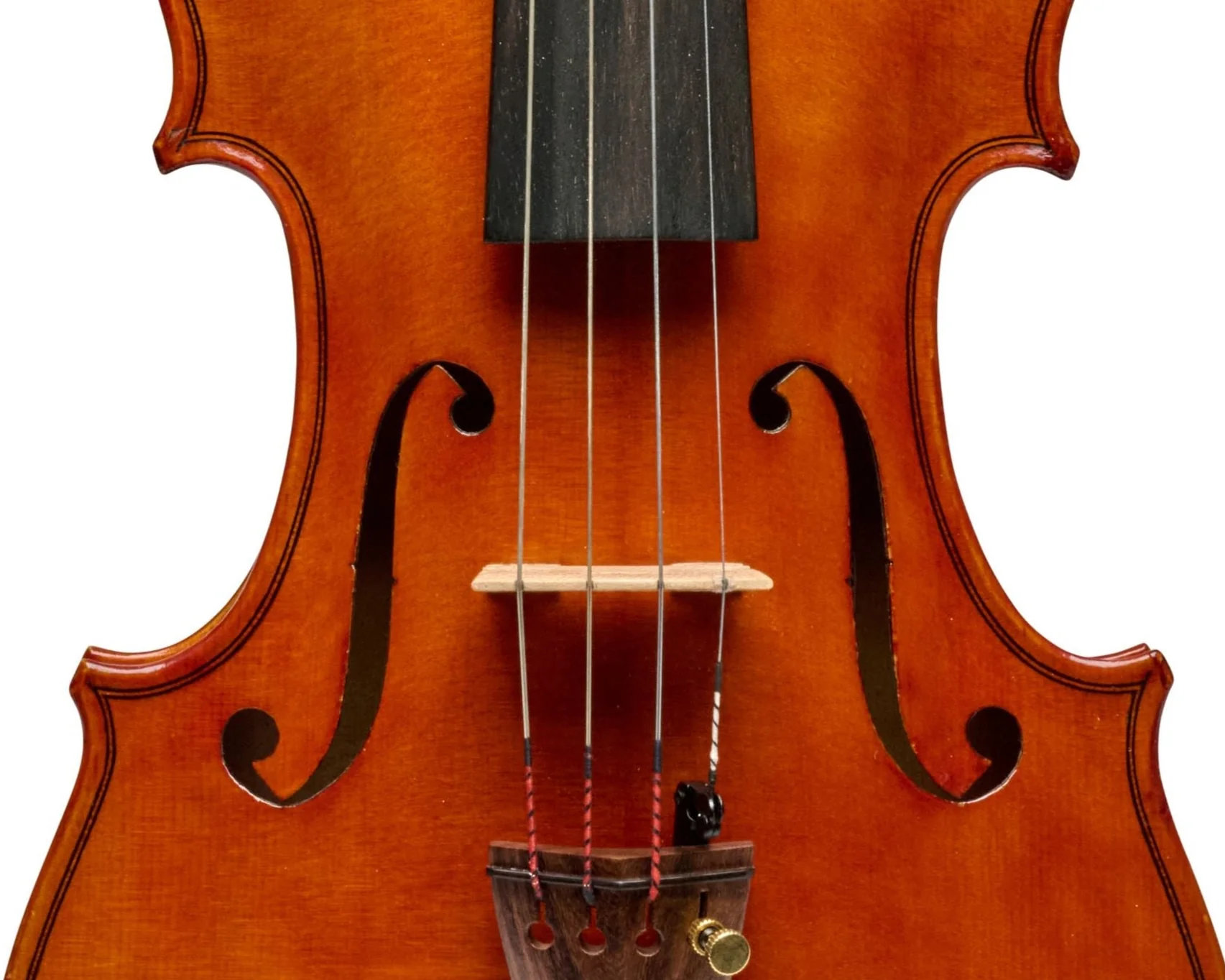
Erwin Hertel Viola, New York, 1972, 16"
Erwin Hertel
Fecit New York 1972
Back Length: 411mm
Upper Bout: 190mm
Center Bout: 133mm
Lower Bout: 246mm
The back is of one piece of maple cut on the quarter of narrow width flame descending slightly from the left to right. The ribs are of similar maple. The scroll is of wider flamed maple. The top is of two pieces of spruce cut on the quarter of medium width grain narrowing at the flanks. The varnish is orange over a golden ground.
Erwin Hertel (b.1911 d.1985) began his studied at the age of 14 in Markneukirchen, Germany. At 19, Hertel travelled to the United States where he worked in Philadelphia. In 1945, he joined Emil Herrmann's shop in New York City where he studied with Simone Fernando Sacconi. Hertel established his shop on Long Island in 1952 where he made new instruments as well as restored those from great players such as Joseph Gingold and Benar Heifetz. In 1961, he opened a studio in Carnegie Hall to better serve travelling players. Hertel later moved to PIttsburgh where he established another shop and continued new making and restoration.
Product Information
Product Information
Shipping & Returns
Shipping & Returns
Description
Erwin Hertel
Fecit New York 1972
Back Length: 411mm
Upper Bout: 190mm
Center Bout: 133mm
Lower Bout: 246mm
The back is of one piece of maple cut on the quarter of narrow width flame descending slightly from the left to right. The ribs are of similar maple. The scroll is of wider flamed maple. The top is of two pieces of spruce cut on the quarter of medium width grain narrowing at the flanks. The varnish is orange over a golden ground.
Erwin Hertel (b.1911 d.1985) began his studied at the age of 14 in Markneukirchen, Germany. At 19, Hertel travelled to the United States where he worked in Philadelphia. In 1945, he joined Emil Herrmann's shop in New York City where he studied with Simone Fernando Sacconi. Hertel established his shop on Long Island in 1952 where he made new instruments as well as restored those from great players such as Joseph Gingold and Benar Heifetz. In 1961, he opened a studio in Carnegie Hall to better serve travelling players. Hertel later moved to PIttsburgh where he established another shop and continued new making and restoration.